VN
VN
Industrial electrical wire plays a crucial role in transmitting electrical power in factories and industrial zones. When the wrong cable type is selected, businesses not only waste investment costs but also face serious fire and explosion risks. The consequences include production disruptions and threats to industrial electrical safety.
This article is advised by Ngoc Lan Cable engineers, providing knowledge about:
- Detailed structure and distinction from residential wire
- Classification according to IEC/TCVN for specific applications
The content also presents applications along with the 4-step process for selecting electrical cables for projects. Understanding the definition and basic structure from the initial steps helps make appropriate selections.
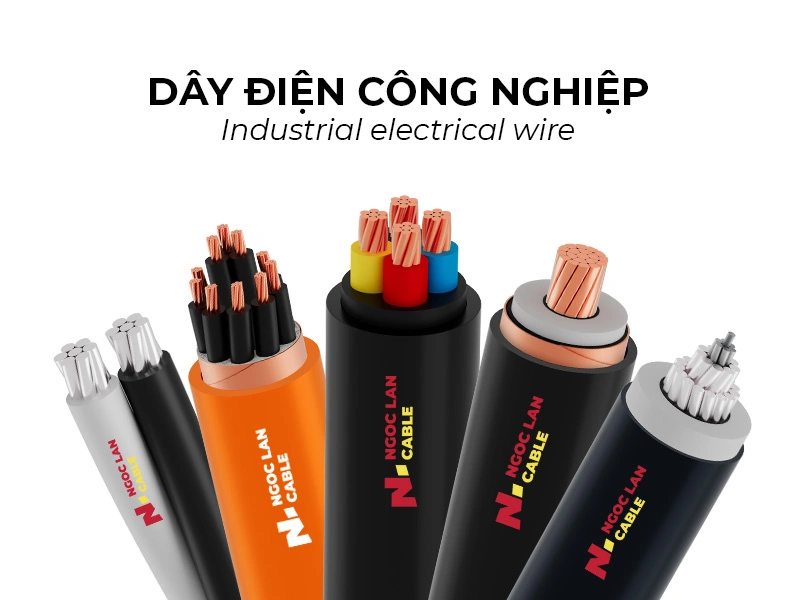
1. What is industrial electrical wire? Distinguishing it from residential wire
Industrial electrical wire is a type of conductor designed to handle high current loads, which can have one or multiple cores, and is typically used in industrial factories and facilities with large power consumption. The key difference from residential wire lies in its significantly higher load-bearing capacity and mechanical durability.
The structure of industrial electrical cables consists of 3 main components:
Conductor: Made from copper or aluminum, responsible for carrying the main electrical current. Technical specifications:
- Cross-sectional area from 1.5mm² to 400mm², meeting high power requirements in industrial applications.
- Solid wire structure (Class 1, 2) used for fixed installation in conduits or cable trays.
- Multi-stranded wire (Class 5, 6) used for flexible connections to electrical panels and mobile machinery.
Insulation
The outer layer surrounding the conductor is the insulation layer. Common materials include PVC with heat resistance up to 70°C or XLPE with heat resistance up to 90°C. This layer prevents current leakage and protects the cable against external environmental impacts. Insulation thickness is applied according to IEC 60502 standard.
Sheath
The outermost layer protecting the entire structure is the sheath. The sheath is made from PVC or LSZH (Low smoke zero halogen) with high mechanical durability. It resists chemicals, oils, and prevents fire propagation according to IEC 60332 standard.
Key differences
| Characteristic | Industrial wire | Residential wire |
|---|---|---|
| Cross-section | 1.5-400mm² | 0.5 – 10mm² |
| Voltage | 0.6/1kV – 35kV | 300/500V or 450/750V |
| Structure | Multi-layer complex | 2-3 simple layers |
| Environment | Heat-resistant, chemical-resistant | Indoor conventional use |
Understanding the structure helps approach the detailed classification method.
2. Classification of industrial electrical wire according to technical standards
The classification of industrial electrical wire helps engineers accurately select the appropriate cable type for each application. Cables are typically classified based on 3 main components: conductor structure, insulation material, and number of cores.
2.1. Classification by conductor structure
Rigid conductor cables use solid wire or multiple wires stranded together, which can be concentric stranded or circular compacted (the number of wires can be 7, 19, 37, 61). The conductor complies with Class 1 or Class 2 according to TCVN 6612 standard (equivalent to IEC 60228). Due to high rigidity, they are typically used for fixed installation in factory power distribution systems.
Flexible conductor cables have conductors stranded from many small-diameter, flexible wires (Class 5 or Class 6 conductor according to TCVN 6612 standard). This structure, with the advantage of flexibility, is suitable for connecting electrical panels and mobile machinery.
2.2. Classification by insulation material
PVC insulated cables are popular with reasonable cost and suitable for most common industrial applications.
XLPE insulated cables have better heat resistance and load-bearing capacity, and are prioritized for electrical systems with high requirements and harsh environments.
See details: Comparison of PVC and XLPE insulated cables
2.3. Classification by number of cores
Single-core electrical cables with simple structure, provide flexibility in installation layout.
3-core electrical cables are the common configuration for 3-phase systems. Some special applications require 4-core cables (3 phases + neutral)
Understanding the classification helps select the right common cable types and practical applications.
3. Types of industrial electrical cables and applications
There are 3 main cable groups according to industrial electrical wire applications: power cables, control cables, and specialized cables. Each type serves specific application environments.
3.1. Power cables
Power cables are the main electrical transmission system for the entire factory, typically divided into 2 types: low voltage power cables and medium voltage power cables.
Low voltage power cables (voltage rating up to 0.6/1kV) account for the majority of applications, with structures ranging from 2 to 5 cores and cross-sections of 1.5 – 400mm². This type is used for power distribution within factories and supplying power to machinery.
Medium voltage cables (voltage up to 35kV) serve long-distance transmission. The structure has multiple layers with copper or aluminum conductors tightly stranded together, and the insulation commonly used is XLPE. Additionally, there is a semiconductor screen layer and metallic armour protecting the cable. The main applications are supplying electrical power to power grids and renewable energy projects.
See details about medium voltage power cables
3.2. Control cables
Control cables are used for signal transmission in automation systems and industrial control equipment, with interference resistance capability. This type typically has multiple cores (2-30 cores) with small cross-sections (1.5-4.0 mm²).
See more details about control cables
3.3. Specialized cables
Specific projects require specialized cables meeting particular requirements.
Fire-resistant cables have sheaths typically made from fire propagation-resistant compounds, with conductors wrapped with additional mica tape, and are commonly used for fire protection and fighting systems in high-rise buildings.
Underground cables have an additional SWA (steel wire armoured) layer or DSTA (double galvanized steel tape armoured) layer protecting the cable from mechanical impacts. The outer PVC sheath helps resist moisture and corrosion, and is used for underground electrical systems in residential areas, industrial zones, and public works.
ABC aerial bundled cables have a structure of 2 to 4 cores with aluminum conductors and XLPE insulation. The cables are commonly used for overhead lines.
See more details about ABC aerial bundled cables
4. How to select industrial electrical wire
Here are the 4 steps in how to select industrial electrical wire for projects, ensuring both safety and cost optimization.
Step 1: Determine the project's technical requirements
The installation environment determines the type of cable sheath. Outdoor applications require UV-resistant sheaths, while underground burial requires additional armour for mechanical protection.
Maximum load current affects the cross-section. Therefore, it is necessary to determine the maximum current, maximum voltage, and total equipment power to calculate the appropriate wire cross-section.
Step 2: Read the industrial electrical wire technical specifications
To ensure selecting the right product, you need to thoroughly study the catalog and datasheet from the manufacturer. These two documents provide complete important technical specifications such as conductor core cross-section, insulation material, voltage rating, and current carrying capacity.
In particular, voltage drop specifications are factors that cannot be overlooked when designing the system. If the cable route is longer than 100m with voltage drop exceeding 3%, equipment performance will be seriously affected.
Step 3: Conduct physical product inspection
Carefully inspect the external appearance of the product such as:
- Labels must be clearly and completely printed: Manufacturer name, specifications, symbols, standards, production batch code…
- Cable sheath must be smooth, not rough, and without cracks.
- Appropriate flexibility: bending at 90° should not cause sheath cracking or deformation.
- Measure the outer diameter to confirm it matches the standard stated on the label.
Step 4: Choose a reputable electrical cable manufacturer
Once you have a clear understanding of the technical criteria, selecting a reputable manufacturer is the final important step. A professional manufacturer always provides detailed test reports for each batch. Additionally, a clear warranty policy of 24-36 months and an engineering team ready to provide support are also criteria of units worth choosing.
After completing the 4-step selection process above, you can refer to the section addressing common questions from engineers and contractors in the next section.
5. Frequently asked questions about industrial electrical wire (FAQs)
Below are common frequently asked questions about industrial electrical wire that the engineering team typically receives when providing technical solution consultations.
5.1. How does XLPE insulated cable differ from PVC?
The core difference lies in heat resistance and durability. XLPE insulated cables withstand maximum temperatures of 90°C and have high mechanical durability, suitable for heavy-load applications. PVC insulated cables withstand maximum temperatures of 70°C and have lower durability than XLPE insulated cables, suitable for common applications.
5.2. How should industrial electrical cables be maintained?
Proper maintenance of electrical cables not only helps extend their lifespan but also ensures operational safety for the entire electrical system.
- Conduct physical inspections every 6 months: pay attention to cracks, discoloration, or signs of overheating.
- Retighten protective connectors to ensure electrical contact is always in optimal condition.
- Check cable temperature using thermal cameras to detect abnormal hot spots.
- Prevent cables from contacting corrosive chemicals or temperatures exceeding design limits.
5.3. Why must cables meeting TCVN/IEC standards be used?
First, using cables meeting standards is a mandatory legal requirement. Regulatory authorities will require presentation of certificates of standard compliance during project acceptance testing. Lack of certification leads to rejection of acceptance testing and penalties for contract violations.
Second, TCVN and IEC standards ensure cables have undergone rigorous testing processes. Specifically, insulation material quality, load-bearing capacity under harsh conditions, and fire and explosion safety are all thoroughly inspected before products enter the market.
For deeper consultation on specific projects, the engineering team is always ready to provide support.
6. Conclusion and solution consultation
After learning about everything from basic structure and classification according to standards to the detailed 4-step selection process, you can see that selecting the right industrial electrical wire is a decision for long-term operational safety. This decision will directly affect the stability and operating costs of the system for the next 20-40 years.
Ngoc Lan Cable, with capabilities certified by EVN (Vietnam Electricity) through safe grid operation certification, provides safety solutions for all industrial projects.
If you need detailed consultation on selecting appropriate cable types, calculating cross-sections according to actual loads, or finding solutions for specific environments, please contact Ngoc Lan Cable immediately. Ngoc Lan Cable's expert team will provide consultation and offer the most optimal technical solutions and costs.