VN
VN
Measurement errors are a common cause of inspection failure in underground electrical system installation. Many engineers often confuse trench depth with actual cover depth. This is a strictly controlled requirement in FDI projects and international standard constructions.
The NEC code for underground PVC conduit specifies exact measurement methods. This article systematizes accurate burial parameters based on NEC Article 300.5 and NEC Table 300.5. The content includes:
- NEC Table 300.5 requirements for minimum cover that engineers need to know
- Standard depth for each installation environment (general, traffic areas, with concrete protection)
- Technical differences between PVC schedule 40 and schedule 80 conduits
The wall thickness difference between schedule 40 and schedule 80 directly affects impact resistance. Therefore, Ngoc Lan Cable presents the right conduit selection for each specific location. This decision affects both cost and safety of the underground electrical system.
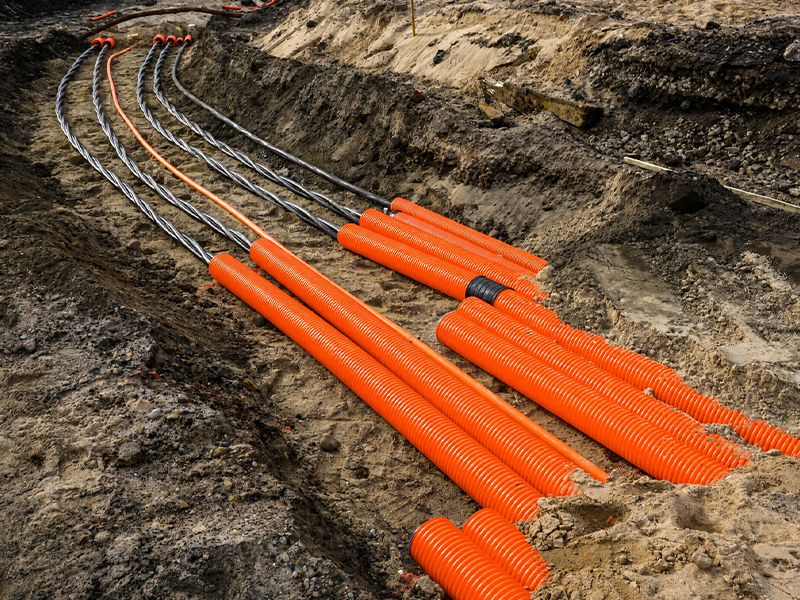
1. What is NEC table 300.5 minimum cover requirement?
Minimum cover is the mandatory protection distance according to NEC. This distance is measured from the finished grade surface down to the top surface of the protective conduit. The measurement method does not include the height of the conduit itself.Underground PVC conduits bear continuous compression load from surface activities. If depth is insufficient, this pressure can cause deformation or conduit breakage. Therefore, besides complying with NEC minimum cover, selecting conduits with suitable load-bearing capacity is crucial. Proper gravel bedding design and burial depth also ensure mechanical load resistance from the surface.
NEC Table 300.5 specifies different minimum cover levels for nonmetallic raceways. Among these, 18 inches (equivalent to 450 mm) is the cover level commonly applied for nonmetallic raceways in normal installation conditions.Engineers must comply with the appropriate minimum cover level according to NEC Table 300.5. This ensures adequate physical protection for the cable system inside the conduit.
2. NEC code for underground PVC conduit burial depth?
Depth standards for nonmetallic raceway systems change according to installation environment. NEC classifies into 4 main groups with separate cover requirements:
| Installation environment | Minimum cover | Application conditions |
|---|---|---|
| General areas | 18 inches (450 mm) | No traffic load, natural soil |
| Under roads and parking lots | 24 inches (600 mm) | Bears commercial vehicle load, must resist compression |
| With concrete protective layer | 12 inches (300 mm) | Concrete encasement ≥ 2 inches thick, reduces depth requirement |
| Under buildings | 0 inches | If there is concrete slab or equivalent protection layer |
Special requirements for traffic areas
Areas bearing driveway and vehicle traffic loads create high-intensity mechanical compression force on PVC conduits. These areas include roads, parking lots, and areas where trucks operate regularly.NEC requires mandatory cover to increase to 24 inches (600 mm) at these locations. The additional 6 inches depth compared to standard level compensates for pressure from commercial motor vehicles. This prevents deformation or conduit breakage under dynamic loads.
Under concrete encasement slabs
The concrete encasement method uses a protective concrete layer at least 2 inches thick surrounding the entire conduit perimeter. This concrete structure creates a rigid mechanical barrier. It distributes surface loads and protects conduits from direct impacts.Thanks to this, contractors are permitted to reduce burial depth to 12 inches instead of the standard 18 inches. This method is especially useful in areas with limited excavation depth due to geological conditions.
PVC conduits under building foundations
Conduits installed under concrete slabs or building foundations receive complete protection from the construction structure. The concrete slab creates an absolute load barrier. This eliminates the risk of mechanical impact from outside.NEC allows reducing the cover requirement to 0 inches in this case. However, NEC still requires conduits to be secured and protected from mechanical damage during concrete pouring.
Soil type influence on depth
NEC does not specifically regulate depth requirements by soil type. However, sandy soil or fill soil has unstable characteristics. It is prone to uneven settlement over time. Engineers must consider adding depth in these areas to compensate for grade variations.
3. Comparative evaluation: PVC conduit (schedule 40 vs 80) and direct burial cable
PVC Schedule 40 conduit has standard conduit wall thickness. It is suitable for route sections deep underground with full NEC cover. This type has costs typically 20-25% lower than Schedule 40.In contrast, PVC Schedule 80 conduit has wall thickness about 30–40% thicker than Schedule 40. This increases impact resistance and mechanical damage resistance. NEC recommends using Schedule 80 at points where conduits emerge above ground. These locations are vulnerable to impacts from surface activities.
Selection between solutions depends on specific project conditions:
- Schedule 40 conduit: Use for deep underground routes without special loads. Also for areas with minimal construction activity.
- Schedule 80 conduit: Mandatory for stub-ups, traffic areas, and zones with high impact risk.
- Direct burial cable: Choose when there is no expansion plan and you want to reduce initial installation costs.
In practice, conduit systems have 20-30% higher initial investment than direct burial. However, this solution provides superior flexibility in long-term operation and maintenance. This is especially true for industrial projects with expansion plans.
See more details: Guide for underground cable house to garage installation
4. Frequently asked questions (FAQ)
4.1. What is the minimum depth for low-voltage landscape lighting systems?
Landscape lighting cable systems under 30V (low-voltage landscape lighting) have low electric shock risk. Therefore, NEC permits reducing burial depth under certain conditions such as: the system is listed, has GFCI protection, and is not located under heavy traffic areas.
The specific minimum depth depends on the footnote of NEC Table 300.5. Not all cases are 6 inches. This regulation allows more flexible installation for garden underground cables, automatic irrigation, and walkway lighting. However, compliance with NEC requirements is still mandatory.
4.2. Is additional protection needed for PVC conduits at the connection point to the electrical panel?
PVC conduit sections from underground to above ground (stub‑ups) are vulnerable to impacts. Therefore, they need more careful protection. NEC requires conduits that are ‘subject to physical damage' to use PVC Schedule 80 or equivalent metal conduit.
In practice, conduit sections from minimum burial depth underground up to 8 feet above ground require protection. These areas frequently experience collisions. They are usually required to use Schedule 80 for protection when connecting to electrical panels or junction boxes.
5. Ensuring NEC compliance and underground cable system quality
Accurate compliance with NEC Table 300.5 standards and NEC code for underground PVC conduit requirements determines the success of the entire underground electrical project, from installation through inspection acceptance. Measurement deviations or wrong conduit type selection can lead to systems failing physical safety requirements and approval.
Below are the main technical points that M&E contractors need to master:
- Accurate measurement method: Always measure cover from finished grade down to conduit top surface, not trench bottom.
- Depth requirements by environment: Maintain 18 inches for general areas, 24 inches for traffic zones, 12 inches with concrete encasement. Increase 10-15% in weak soil areas to compensate for grade variations.
- Appropriate conduit and cable selection: Schedule 40 for deep underground routes, Schedule 80 mandatory for stub-ups. Direct burial cable requires 24 inches.
The integrity of the underground electrical network depends equally on protective conduit quality and insulation durability of the core cable system. Contact Ngoc Lan Cable for detailed expert consultation for your project.